
Weigh India against every other place you could build.
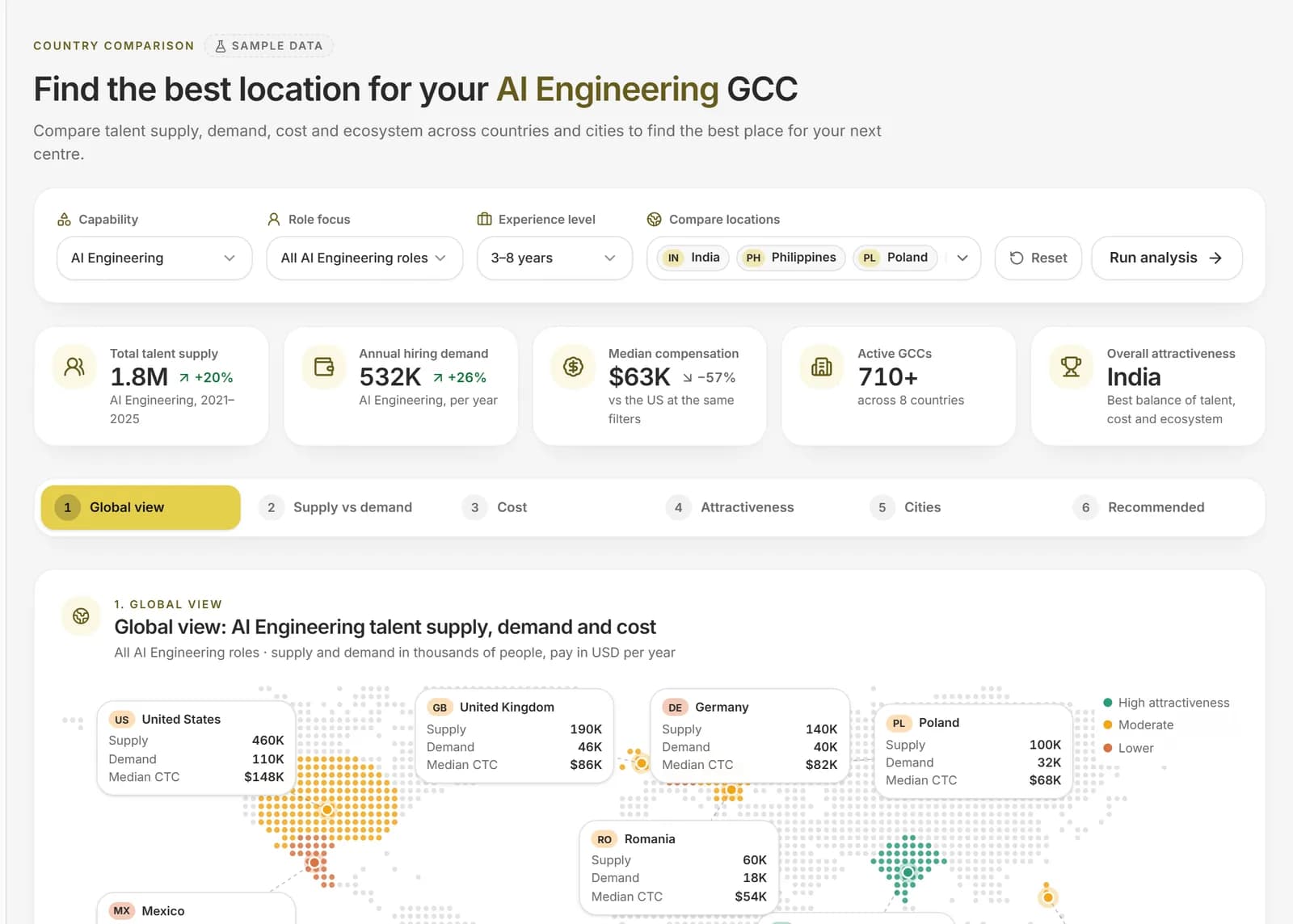
A GCC decision often starts by comparing countries before it compares cities. CapSight sets the locations you pick side by side on talent supply, hiring demand, cost and ecosystem for a role family, scores their attractiveness on five weighted measures, and then narrows to cities within the winner.
 Sample data
- Supply, demand and cost by country
- An attractiveness score on five measures
- Then down to cities within a country
The GCC list this page draws on.
 Sample data
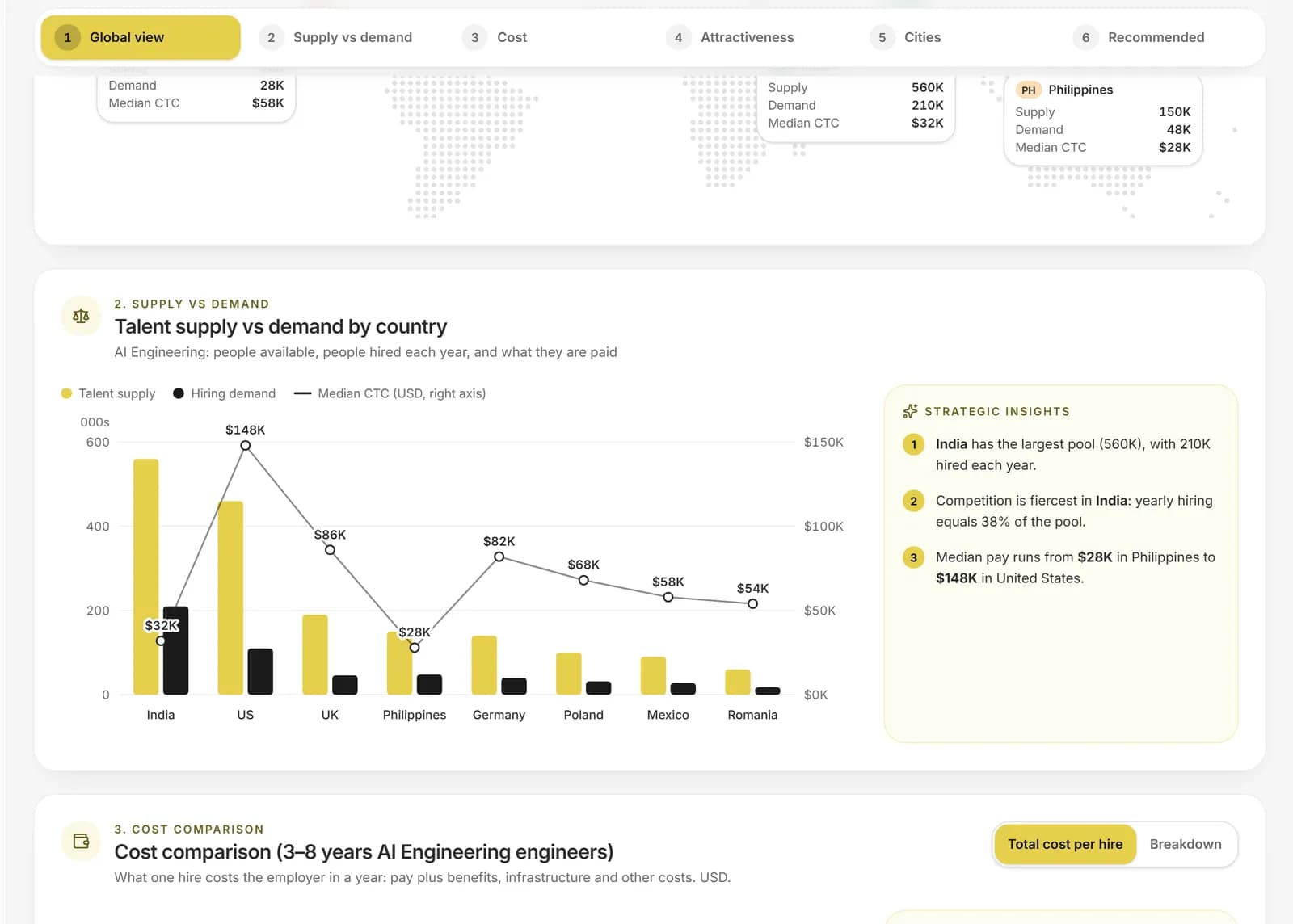
Where talent is plentiful and where hiring is fiercest.
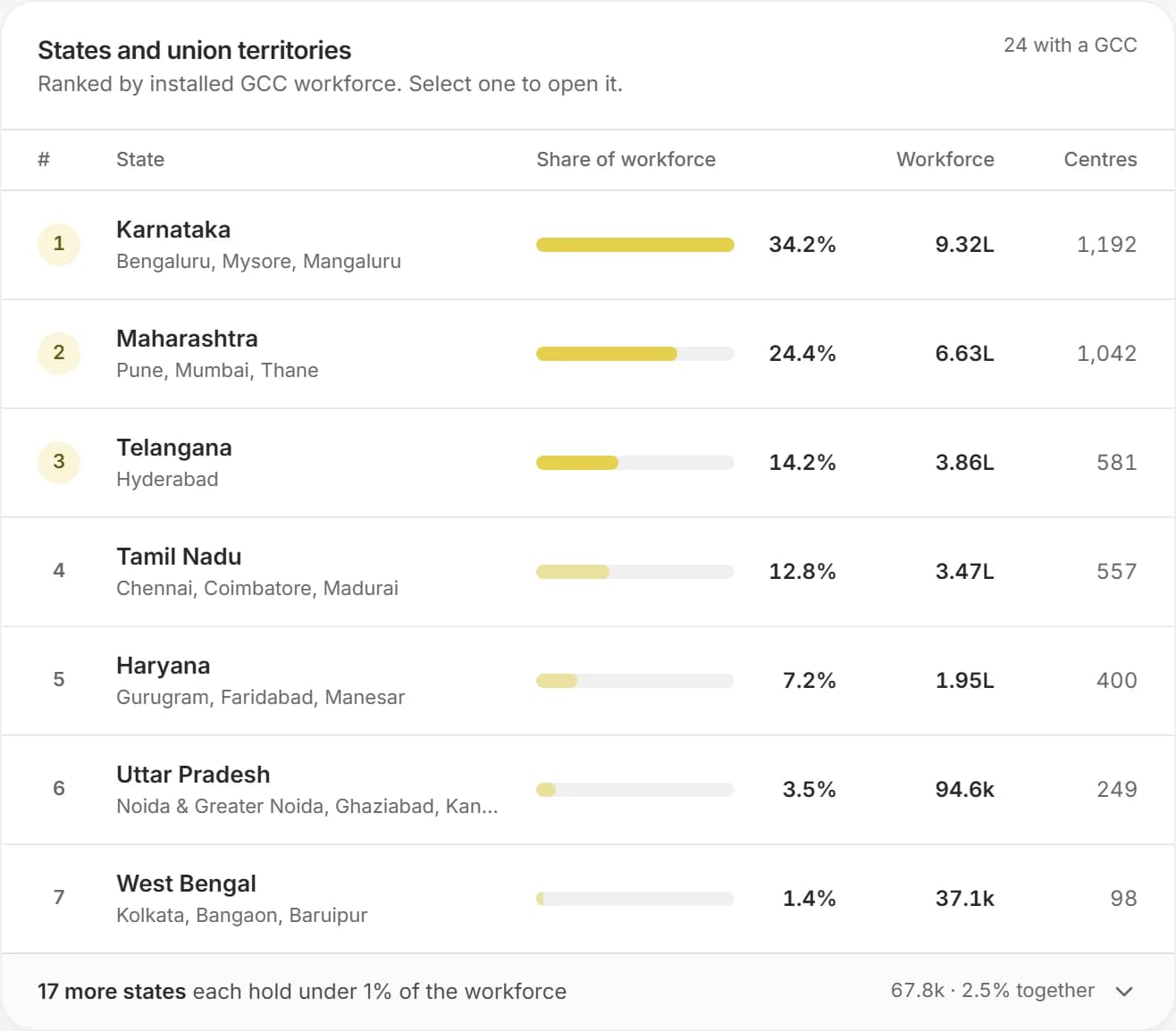
A screen from the product itself. The counts beside it are read from the platform directory.
- 57
- global HQ countries
- 2,500
- company profiles
- 35
- Indian cities with a centre
- 2.85M
- people in GCCs across India
Compare Countries, in four parts.
Each part is something the product does today, with the data it uses named on the page.
Supply against demand
How many people are available, how many are hired each year and what they are paid, for each country, so scarcity and competition are visible together.
Cost per hire
The total cost of one hire in a year, with pay, infrastructure and other costs shown as parts, so a cheap salary is read against what surrounds it.
An attractiveness score
Talent availability, cost efficiency, ecosystem maturity, policy incentives and time to hire, weighted and combined into one score you can adjust.
From country to city
The cities inside each country, ranked, and a recommendation that names the trade-offs in plain words.

One market, twelve decisions.
The same list of GCCs, the same cities and the same pay benchmarks sit under every solution, so where to build, what to build, what to pay and whom to hire are answered from one set of facts that agree with each other.
Request access- 0.0%
- Of the workforce is in Bengaluru
- 0
- Mega GCCs, over 10,000 people each
- 0
- GCCs set up since 2021
- 0
- States and union territories with a centre
How a country is scored
Five measures with stated weights. The weights are visible so a different priority can be argued openly.
- MeasureTalent availabilityWeight30%What it asksIs there enough of the right talent to hire from?
- MeasureCost efficiencyWeight25%What it asksWhat does one hire cost once everything is counted?
- MeasureEcosystem maturityWeight20%What it asksAre peers, suppliers and universities already there?
- MeasurePolicy incentivesWeight15%What it asksWhat does the government offer a new centre?
- MeasureTime to hireWeight10%What it asksHow long until the seats are filled?
Ask the question the way you would ask a colleague.
These are the kinds of questions this page is built for. Each one is answered from the data on it, not from a general model of the market.
Where is the best place for an AI engineering centre: India, the Philippines or Poland?
How does talent supply compare with hiring demand in each country?
What does one hire cost in each country, once everything is counted?
Which country scores best if cost matters more than ecosystem?
Which cities inside the leading country should we look at?
How many GCCs are already active in each country?
From first look to a decision you can show.
Name the capability
Choose the capability, role focus and experience level you are planning to hire.
Pick the places
Add the countries you want to compare, up to the set the screen allows.
Read the five views
Move from the global view through supply, cost and the attractiveness score to cities.
Take the recommendation
Read the recommended place and its trade-offs, then carry it into a location study.
Built for the people who own the decision.
Global leadership choosing where to build
A comparison across countries before the city work starts.
Finance partners
A cost per hire that includes more than salary.
Heads of existing centres
How India's case holds against the alternatives the parent will raise.
What is in it, and what is not yet.
We say plainly what the data holds today and what we are still adding, so nothing here is implied.
- Country comparison for a capability, role focus and experience level
- Supply, demand and cost views, and a weighted attractiveness score
- City rankings within each country
- Country figures drawn from live data (the screens carry sample figures until then)
- More capabilities and more countries
The terms on this page, defined.
Every figure on a CapSight page comes with its definition, so you never have to guess what a number is counting.
- GCC
- A Global Capability Centre: a centre a company runs in India for its own global work, such as engineering, analytics, finance, operations or support. It is part of the company, not an outside vendor.
- Platform Industry
- The one industry grouping CapSight uses for every company, so a filter or a chart means the same thing on every page. There are 10.
- Tier 1 and Tier 2 cities
- Tier 1 is the eight established hubs: Bengaluru, Chennai, Hyderabad, Mumbai, Pune, Delhi NCR, Kolkata and Ahmedabad. Every other city is Tier 2.
- CTC
- Cost to company: the annual total an employer commits to one person, shown in lakh rupees. One lakh is 100,000.
- Percentile band (P25, P50, P75, P90)
- P50 is the median: half the people in the sample earn less. P25 and P75 mark the edges of the middle half, and P90 marks the top tenth. A pay figure is always read with its band.
- Build journey
- A documented account of how a comparable centre started: its first city, its first team and how it grew, with each figure cited to its source.
Before you ask.
Are the figures real?
They are sample figures and the screen is labelled so. The layout, the scoring method and the flow are the product; the live data follows.
Can I change the weights?
The weights are shown so you can see what drives the score. Adjusting them is not available yet.
Does it cover India in depth?
Yes. India is the platform's home market, with states and cities in detail, so a country decision can continue straight into location work.
Bring the GCC decision you are working on.
Where to put the next 300 engineers, what a peer pays its architects, who owns the charter you are selling into. Ask it in CapSight, and see the market, the peers and the people behind the answer.
Already on CapSight? Sign in
- 01Request access
We set up your organisation and its admin, who adds the team.
- 02Ask the question you have
Market, peer, pay or people, answered from one dataset.
- 03Walk it through with us
A 30-minute session with the research desk, on your decision.

Capability maturity of five BFSI GCCs in Bengaluru, by function.
Illustrative example