
Measure what your centre can do against the peers who do it best.
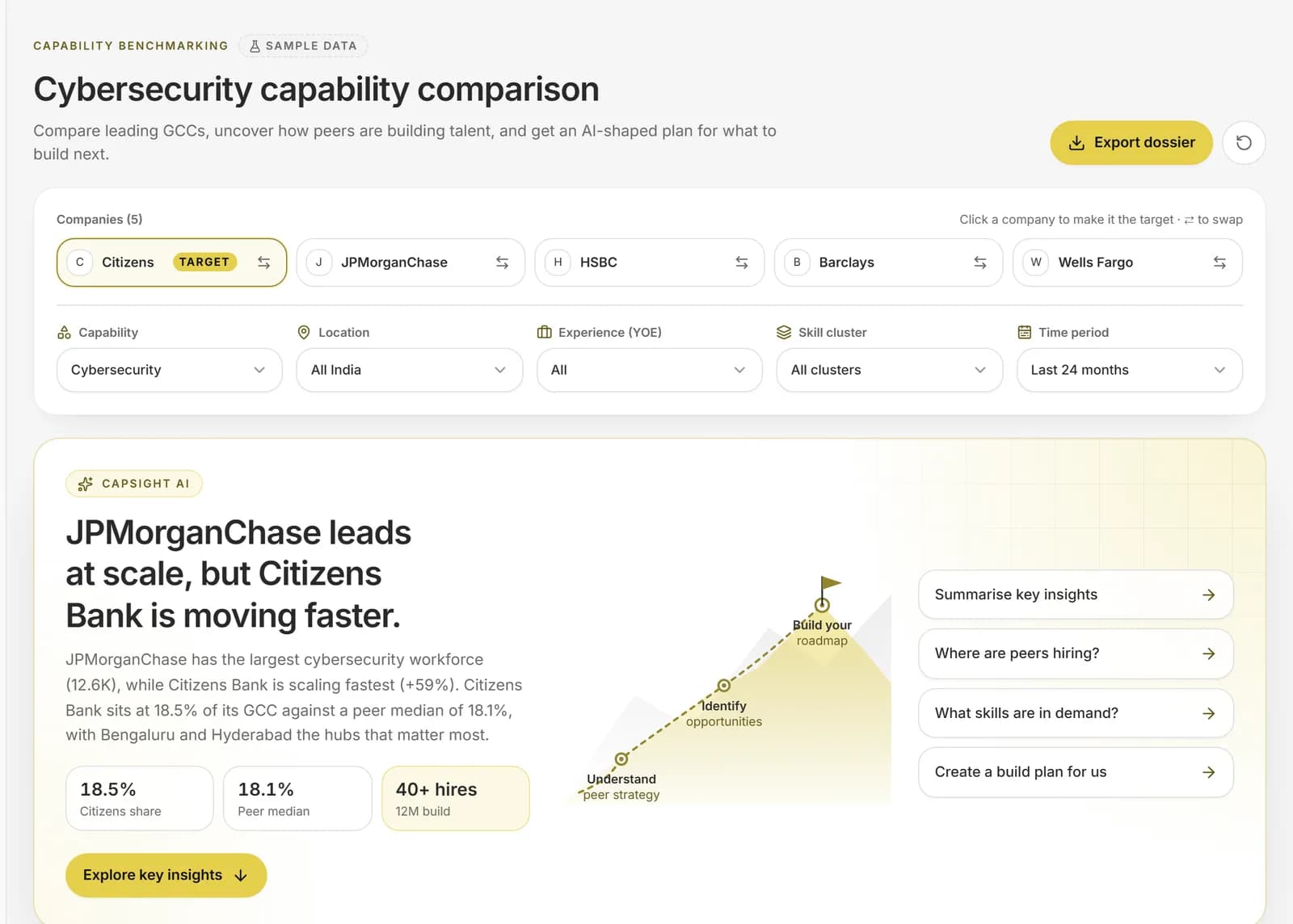
A centre is not only a headcount; it is a set of capabilities, such as cybersecurity or cloud or data, and each can be strong or thin against peers. CapSight puts a target company beside four peers on one capability, shows the gaps, and says in plain words what closing them would take.
 Sample data
- One capability, five centres, side by side
- Gaps against the peer median
- A plain-words read-out of what matters
The GCC list this page draws on.
 Sample data
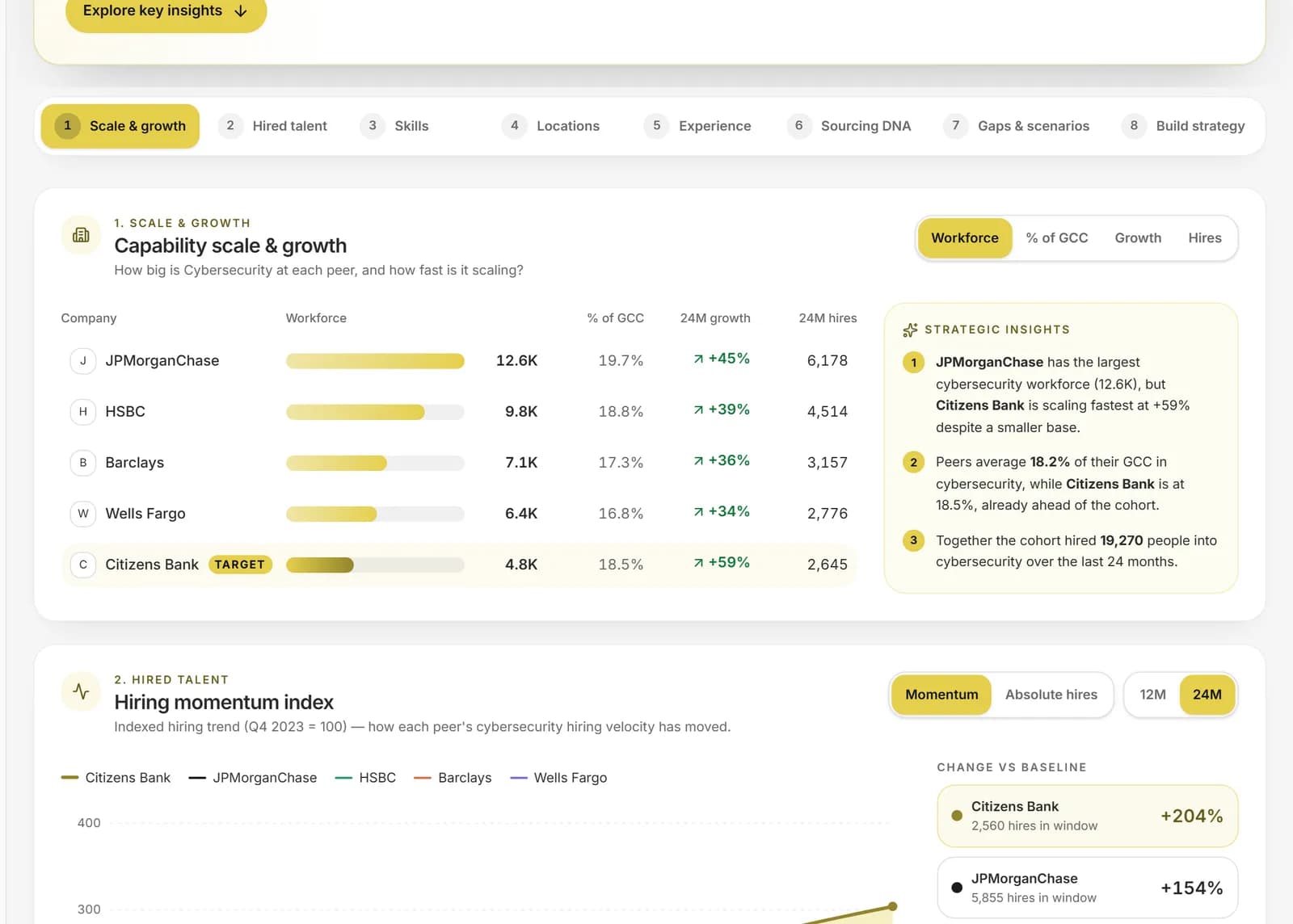
Workforce, share and growth for each peer.
A screen from the product itself. The counts beside it are read from the platform directory.
- 2,500
- company profiles
- 2.85M
- people in GCCs across India
- 43
- mega GCCs, over 10,000 people
- 35
- Indian cities with a centre
Benchmark Capabilities, in four parts.
Each part is something the product does today, with the data it uses named on the page.
A capability, compared
Choose a capability and up to four peers and see scale, share, growth and hiring for each in one view, with the target highlighted.
The gaps, by cluster
Within the capability, each skill cluster shows where the target sits against the peer range and the peer median, and who leads.
Hiring momentum
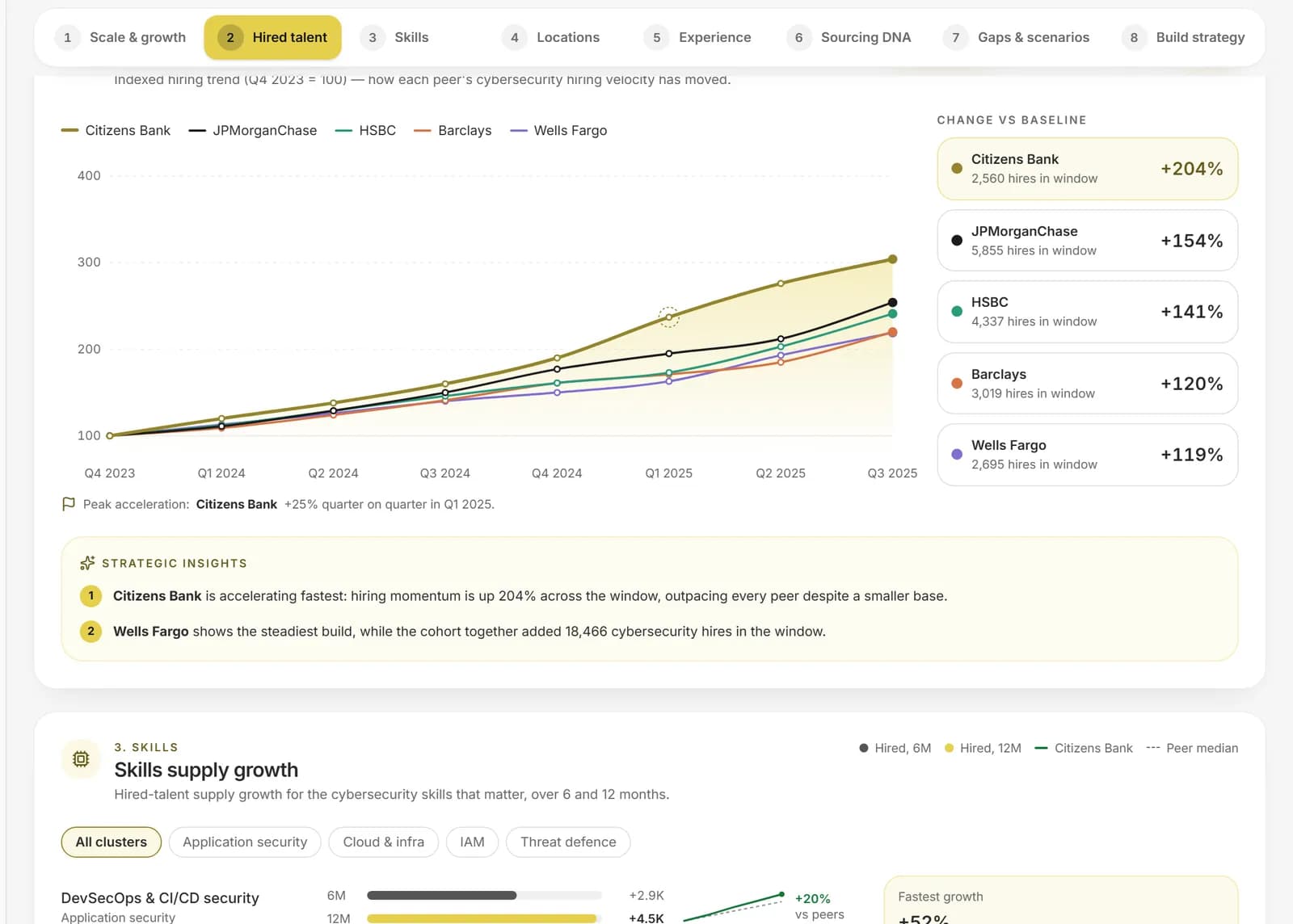
Which peers are adding people fastest in the capability, over twelve or twenty-four months, so you see who is building and who is standing still.
A brief you can act on
A read-out in plain words, a next-step list and an export of the whole dossier to take into the room.

One market, twelve decisions.
The same list of GCCs, the same cities and the same pay benchmarks sit under every solution, so where to build, what to build, what to pay and whom to hire are answered from one set of facts that agree with each other.
Request access- 0.0%
- Of the workforce is in Bengaluru
- 0
- GCCs set up since 2021
- 0
- States and union territories with a centre
- 0
- Companies with pay benchmarks
From a capability to a plan
The benchmark moves from where a centre stands to what it would take to catch up, in four steps.
- Step 1
Scale and growth
How big the capability is at each peer, and how fast it is growing.
- Step 2
Hiring momentum
Who is adding people, and in which skill clusters.
- Step 3
Gaps and scenarios
The distance to the peer median, and what closing it would take.
- Step 4
Build strategy
A short list of moves, with the evidence behind each.
Ask the question the way you would ask a colleague.
These are the kinds of questions this page is built for. Each one is answered from the data on it, not from a general model of the market.
Where does our cybersecurity capability stand against the four peers we compete with?
Which skill clusters are we strongest and weakest in?
Which peer is hiring fastest in the capability, and into which clusters?
What would it take to close the gap to the peer median?
How does our hiring intensity compare, per thousand staff?
Which capability should we strengthen first?
From first look to a decision you can show.
Pick the target and peers
Name your company and up to four peers, then the capability, location and experience level.
Read scale and momentum
See workforce, share and hiring for each, and where the target leads or trails.
Study the gaps
Open the clusters to see the distance to the peer median and who sets the pace.
Export the dossier
Take the read-out and the charts into a report for the people who decide.
Built for the people who own the decision.
Heads of engineering and technology
To know where the centre's capability is thin against the peers it competes with.
Capability and CoE leads
A case for investment built from a comparison, not an opinion.
Strategy teams
Which capability a peer is quietly building up.
What is in it, and what is not yet.
We say plainly what the data holds today and what we are still adding, so nothing here is implied.
- Capability comparison for a target and up to four peers
- Scale, share, growth and hiring momentum by capability
- Gap analysis by skill cluster against the peer median
- A plain-words read-out and dossier export
- Capability figures drawn from the full live data (the screens carry sample figures until then)
- More capabilities beyond the first set
The terms on this page, defined.
Every figure on a CapSight page comes with its definition, so you never have to guess what a number is counting.
- GCC
- A Global Capability Centre: a centre a company runs in India for its own global work, such as engineering, analytics, finance, operations or support. It is part of the company, not an outside vendor.
- Platform Industry
- The one industry grouping CapSight uses for every company, so a filter or a chart means the same thing on every page. There are 10.
- Tier 1 and Tier 2 cities
- Tier 1 is the eight established hubs: Bengaluru, Chennai, Hyderabad, Mumbai, Pune, Delhi NCR, Kolkata and Ahmedabad. Every other city is Tier 2.
- CTC
- Cost to company: the annual total an employer commits to one person, shown in lakh rupees. One lakh is 100,000.
- Percentile band (P25, P50, P75, P90)
- P50 is the median: half the people in the sample earn less. P25 and P75 mark the edges of the middle half, and P90 marks the top tenth. A pay figure is always read with its band.
- Build journey
- A documented account of how a comparable centre started: its first city, its first team and how it grew, with each figure cited to its source.
Before you ask.
Is this live data?
Not yet. The benchmark carries sample figures, and the screen says so, until the capability data is wired to the platform's full data.
Which capabilities are covered?
Cybersecurity first, with more to follow. Each new capability uses the same layout, so comparisons stay readable.
Who counts as a peer?
Any company you choose. The peer median is read across the peers in the comparison, so the choice matters and is yours.
Bring the GCC decision you are working on.
Where to put the next 300 engineers, what a peer pays its architects, who owns the charter you are selling into. Ask it in CapSight, and see the market, the peers and the people behind the answer.
Already on CapSight? Sign in
- 01Request access
We set up your organisation and its admin, who adds the team.
- 02Ask the question you have
Market, peer, pay or people, answered from one dataset.
- 03Walk it through with us
A 30-minute session with the research desk, on your decision.

Capability maturity of five BFSI GCCs in Bengaluru, by function.
Illustrative example